
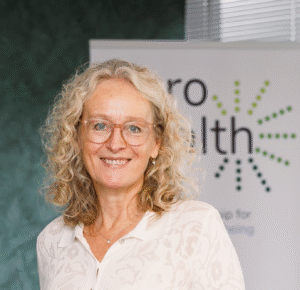
EuroHealthNet Director Caroline Costongs talks to Healthy Europe about the 40th anniversary of the Ottawa Charter and why laws and strategies for accountability are urgently necessary to counter the health risks of the digital age.
Interview: Dietmar Schobel
HEALTHY EUROPE
The Ottawa Charter for Health Promotion by the World Health Organization (WHO) was drawn up in 1986 as a fundamental document for health promotion in our modern world. How relevant is it today, Ms. Costongs? Does the Charter need a reboot?
Caroline Costongs: The WHO Ottawa Charter is still as relevant today as it was 40 years ago – it provides guidance on the core principles of health promotion. The same applies to its five key action areas: building healthy public policy, creating supportive environments, strengthening community action, developing personal skills and reorienting health services. That means there is no need to reboot the Ottawa Charter, but when applying it, we must factor in how our environments have changed over the past four decades. Digital technology is one of the biggest challenges here. Digital environments, including social media, and artificial intelligence, are developing at an ever-increasing pace. They have a huge influence on our lives and everyday routines – frequently in ways that put our health at risk.
HEALTHY EUROPE
How can we respond to the health challenges presented by digital progress?
Credit: EuroHealthNet
Caroline Costongs: We are well aware of what needs to be done. Legislation, regulation and accountability strategies are urgently necessary – such as the European Union Digital Services Act, which addresses many of the dangers in the digital environment. However, this EU legislation is not being adequately applied. What we really need here are national authorities that strictly monitor compliance with these EU requirements and hold the tech industry accountable. And that calls for the relevant political will, and more courage. As public health experts, we need to advocate for this commitment by policy decision-makers.
We need decision-makers with more courage to regulate power and profits of the Big Tech enterprises.
CAROLINE COSTONGS, DIRECTOR OF EUROHEALTHNET
HEALTHY EUROPE
A lot of people think there are already far too many regulations in the EU. Why do we need to introduce even more legislation for the digital environment? Or at least, why should we monitor existing regulations even more closely?
Caroline Costongs: Big Tech can only be pressured to making products that don’t harm us, and are ideally even supportive to health, if they are compelled to do so by the appropriate laws. Technically, they have all the resources to do so. Digital tools can evidently be programmed to generate maximum profit. And so, they can also be designed to have zero negative impact on our well-being. In addition, we need to ensure that we strengthen our personal capabilities to protect our health while operating in digital environments. Classes and workshops at schools and workplaces are just one option. The EU needs to be a frontrunner here; it should invest in the health and wellbeing of its people, and demonstrate that this works better than current strategies witnessed in the US and other regions of the world – instead of, in other words, joining the race to the bottom.
HEALTHY EUROPE
What are the other challenges facing societies overall and health promotion in particular right now?
Caroline Costongs: Climate change is an urgent matter of concern , and its adverse effects on our health will intensify even more over the coming years and decades. Living in a way that contributes to good health can go hand in hand with protecting the climate. There has to be an increasing focus on how we can best adapt to the consequences of climate change. It is especially vulnerable groups of the population that suffer most from the consequences.
HEALTHY EUROPE
Who exactly are these population groups, and in what way do they suffer?
Caroline Costongs: They include people who are elderly or sick, young children and infants, and also socially disadvantaged people with low incomes. For example, people with limited financial means are hit especially hard by heatwaves. They are more likely to live in poorly insulated flats in urban neighbourhoods that are heat-prone and densely populated. Air conditioning is often unaffordable for them, and they are more likely to do physically demanding work outdoors. Generally speaking, social inequalities in health have worsened overall in Europe in recent years. Therefore, one of the most important tasks facing everyone involved in health promotion and taking the Ottawa Charter forward is to work towards reducing this gap. A new EuroHealthNet online guide aims to help secure funds for these and other measures for health promotion and prevention. It combines evidence, tools, strategies, financing approaches and real-world examples. The guide is available online at https://eurohealthnet.eu/publication/making-investments-in-prevention-and-health-promotion-happen.
HEALTHY EUROPE
Is enough money being invested in health promotion and prevention at present?
Caroline Costongs: Despite clear evidence of the benefits, prevention and health promotion still receive less than 3 percent of healthcare budgets. Yet non-communicable diseases, which are often preventable, account for up to 80 percent of healthcare costs. This imbalance is a missed opportunity: investing in prevention not only improves wellbeing but also reduces long-term costs and relieves pressure on health systems. An OECD study from April 2026 shows that targeted health promotion and prevention measures can have a big impact even with relatively small financial means. For instance, every euro invested in government regulations that restrict the marketing of unhealthy foods to children can generate an economic return of up to 6 euros. But the greatest leverage lies in shaping our economy overall to become more supportive of health. In many respects, the current system is actually harming us. We need to move forward to an economy of wellbeing where health equity can flourish.
EUROPE’S VOICE FOR HEALTH PROMOTION
EuroHealthNet is the European Partnership for health, equity and wellbeing and is headquartered in Brussels. Its team of 22 people coordinates policy, advocacy, research, and capacity-building activities that help address health inequalities and improve the determinants of health in Europe. It was originally founded in 1996 as the European Network of Health Promotion Agencies (ENHPA). The network is open to national and regional organisations for health promotion, public health and prevention in Europe and currently has over 80 members and associate members – ranging from Austria’s National Public Health Agency and the Flanders Institute for Healthy Living to Public Health Wales.