
The Portuguese National School Health Programme was set up to turn schools into nationwide settings that benefit health. Its measures systematically integrate the principles of the Ottawa Charter.
Text: Dietmar Schobel

“The Portuguese National School Health Programme is firmly grounded in the principles of the Ottawa Charter for Health Promotion of the World Health Organisation,” emphasises Gisela Dias Leiras, Head of Division of Literacy, Health & Well-being at the Directorate-General of Health, Portugal. She explains: “The programme explicitly refers to the Charter throughout its strategy, and supports Portugal’s participation in the WHO Network for Health-Promoting Schools.”
In line with this, the Portuguese National School Health Programme (Programa Nacional de Saúde Escolar – PNSE) places a strong emphasis on transforming schools into settings that benefit health. Furthermore, it has helped develop and implement several public policies, including legal standards for food provision in schools and Portugal’s recent national policy that restricts mobile phone use in schools.
39 Local Health Units
Since 2024, healthcare provision in mainland Portugal has been organised into 39 Local Health Units (Unidades Locais de Saúde – ULS), bringing together primary, hospital and other healthcare services within the same organisational structure. Within each ULS, a Local School Health Team (Equipa Local de Saúde Escolar – ELSE) is established to coordinate and support the implementation of the National School Health Programme at local level.
These teams are multidisciplinary and intersectoral, bringing together, among others, doctors, nurses, environmental health technicians, nutritionists, psychologists and social workers. Their work focuses primarily on the health and wellbeing of children and adolescents, but their target population encompasses the whole educational community, including teachers, non-teaching staff and families.
Programmes and projects
The Local School Health Teams work closely with schools, municipalities and other community partners to promote health in educational settings. They implement programmes and projects that focus on balanced diets, sufficient exercise, sexual health, prevention of addiction and violence, and increased health literacy. Their work can also include interventions related to epidemiological surveillance, vaccination and screening, according to local needs and national health programmes.
Children with special health needs, for example with diabetes, epilepsy or serious allergies, receive bespoke care from these teams. They also train the school staff on how to respond to these health needs. An individual health plan is developed for each child with special health needs.
Risk assessments
Additionally, the Local School Health Teams undertake environmental risk assessments, generally every three years. These focus on hygiene standards, workplace ergonomics for schoolchildren and teachers, the quality of heating and cooling systems, noise pollution and air quality, among other aspects.
In June 2026, children aged between 0 and 6 years as well as students aged 18 upwards were integrated into the PNSE – until then, it only covered schoolchildren aged 6 to 18. “The spectrum of measures has been considerably expanded, too,” says Gisela Dias Leiras. One example of these extra assessments by the Local School Health Teams is the local food environment in an area of approx. 200 metres from the schools. This examines whether there are fast-food restaurants or advertising, or whether alcohol and tobacco are sold or advertised near a school.
Implementing proven methods
Supporting and implementing local, regional and national health promotion projects and programmes is a key part of the work performed by the PNSE. A database with best-practice examples is scheduled to go live at the end of 2026 and is expected to make it easier for health promotion measures that have proven successful in one region to be transferred to other regions. The database will provide evidence-based initiatives such as the following three examples:
* Mais Contigo is a nationwide programme that promotes mental health and prevent suicidal behaviour among schoolchildren aged between 12 and 18. In the 2024/2025 school year, 18,561 adolescents were reached in this way. One of the findings by the evaluation was that the average wellbeing of participants has increased and symptoms of depression have reduced.
Credit: DGS
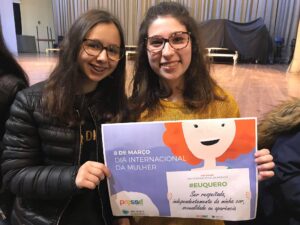
* PRESSE is a programme for sexual education. It provides age-appropriate educational resources and materials, as well as courses that supply teachers with information on how to adopt the best approach when they talk with pupils about sexuality issues. The programme has been implemented in Northern Portugal since 2008. In 2015, it received the World Award for Excellence and Innovation in Sexuality Education for Governmental Programmes by the WAS (World Association for Sexual Health). And in 2027, it is scheduled for expansion throughout the whole country.
* My Lunchbox is a project from the Alentejo region. This initiative aims to achieve a 5% increase in the quantity of bread, milk, yoghurt and fruit consumed by pre-school children and pupils between the ages of 6 and 10, and also to decrease savoury or sweet snacks and soft drinks by 5%.